

Chinese Car Brands are quietly reshaping Europe’s Automotive Aftermarket by GiPA Categories: 2026, News Timelines: Argentina, Brazil, Central America, Chile, China, Colombia, France, Germany, India, Italy, Mexico, Morocco, Peru, Poland, Portugal, South Africa, Spain, Thailand, Turkey, United Kingdom, Vietnam, アルゼンチン, アルゼンチン, イタリア, イタリア
Announcement Date : 24 June 2026
Chinese car brands are no longer a marginal phenomenon in Europe. Their market presence is now becoming structural, especially across the five major European automotive markets: Germany, Spain, France, Italy and the United Kingdom.
In the G5 countries, Chinese brands now account for 9.5% of passenger car registrations in early 2026, compared with 6.3% in 2025. The growth is not homogeneous: Spain, Italy and the United Kingdom are already in double-digit territory, while France and Germany remain in an earlier stage of adoption.
As these vehicles enter the parc, the European after-sales ecosystem will need to address parts availability, technical-data access, diagnostic capability, high-voltage training, warranty rules and the role of authorised versus independent repair channels.
The core strategic question is therefore simple: how ready is the aftermarket to service, repair and support a new generation of vehicles built around different industrial models, electrified architectures and software-enabled service logic?
The latest G5 figures show a clear acceleration in the penetration of Chinese brands. The United Kingdom leads the group with 14.9% of registrations in early 2026, followed by Spain at 14.2% and Italy at 13.5%. France and Germany remain at lower levels, but their current position should not be interpreted as structural immunity. Rather, these markets may still be in the preparation window before parc effects become more visible.
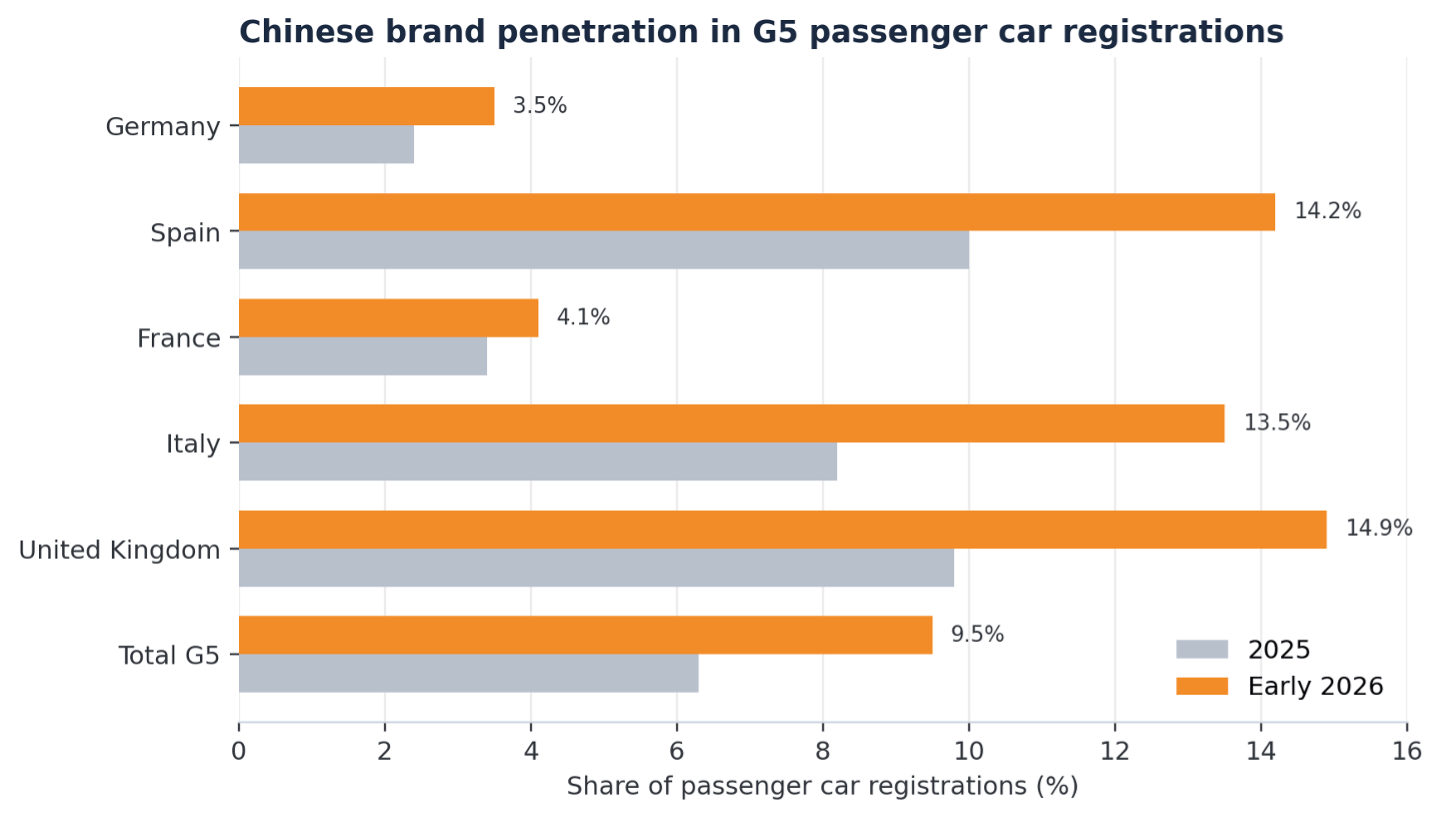
Figure 1 – Chinese brand penetration in G5 passenger car registrations, 2025 vs early 2026. Source: GiPA analysis based on official passenger car registration data.
The rise of Chinese brands introduces new business models, new technical architectures and new organisational patterns that may challenge the way the European aftermarket currently operates.
Key opportunities
The parts ecosystem
Many Chinese vehicle manufacturers operate with a higher level of vertical integration than traditional European OEMs. Batteries, electric motors, electronic systems and even semiconductors may be designed and produced within proprietary industrial ecosystems.
This model can create efficiency at manufacturing level, but it raises important challenges for the aftermarket. Technical references, part codification, homologation processes and component specifications may not always be aligned with established European aftermarket practices. For independent parts manufacturers and distributors, building an alternative parts offer may therefore become both a technical and commercial challenge.
Supply continuity
The Chinese vehicle parc in Europe is still relatively recent, but pressure points are already emerging. Delivery times, catalogue completeness, commercial conditions, return policies and obsolescence risks are all critical factors for the after-sales market.
The challenge is amplified by logistics flows that are still developing across Europe, limited availability of equivalent IAM parts, and a continued dependency on supply chains that remain partly located in Asia. Stock management becomes particularly complex as model ranges expand quickly and vehicle lifecycles accelerate.
Repair access
Access to repair and maintenance information is one of the most strategic issues for the independent aftermarket. In Europe, Regulation (EU) 2018/858 requires vehicle manufacturers to provide independent operators with access to vehicle OBD information, diagnostic tools, software and repair and maintenance information on a non-discriminatory basis.
However, operational reality can still be complex for new entrant brands. Access to technical repair data, diagnostic protocols and software updates may be partial, fragmented or dependent on specific commercial processes. Proprietary diagnostics, over-the-air updates and connected services can create an information asymmetry between authorised networks and independent repairers.
Electrification
A significant share of Chinese models sold in Europe are electric or plug-in hybrid vehicles. This increases after-sales complexity through battery systems, thermal management, power electronics, ADAS, connected services and software-driven components. Technicians need high-voltage certification, dedicated tools and specific diagnostic capabilities.
At the same time, questions around battery lifecycle, repairability, replacement cost and end-of-life management remain only partially stabilised in Europe. This creates opportunities for specialised players, but only for those who anticipate the shift early enough.
Implications for aftermarket stakeholders
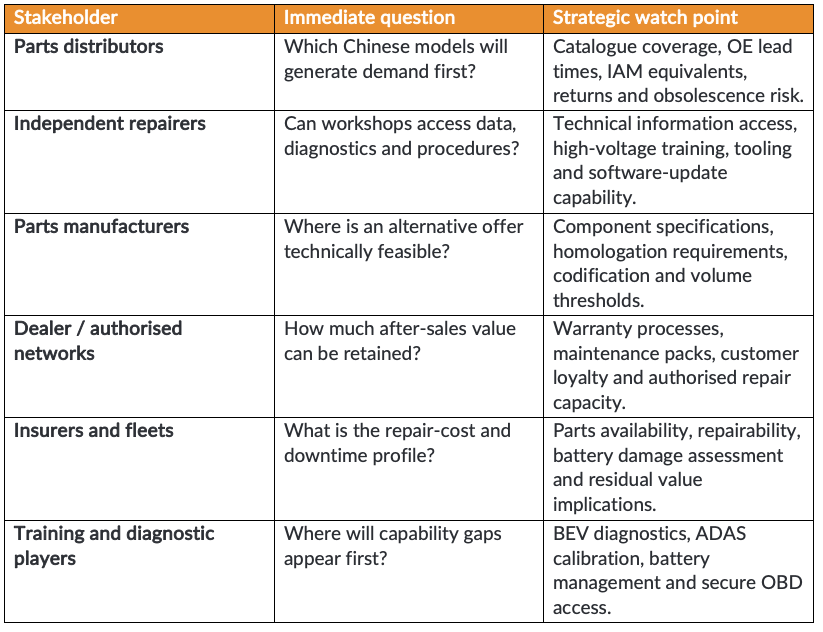
The penetration of Chinese brands creates different priorities depending on the stakeholder position in the aftermarket value chain. The following matrix summarises the main areas to monitor
The GiPA French study: a first operational benchmark
To support the industry in understanding these changes, GiPA has launched an exclusive multi-client study dedicated to the after-sales organisation of Chinese car brands in France.
The study provides a detailed analysis of the French market, including distribution models, repair conditions, parts availability, warranty structures, maintenance policies and access to technical information.
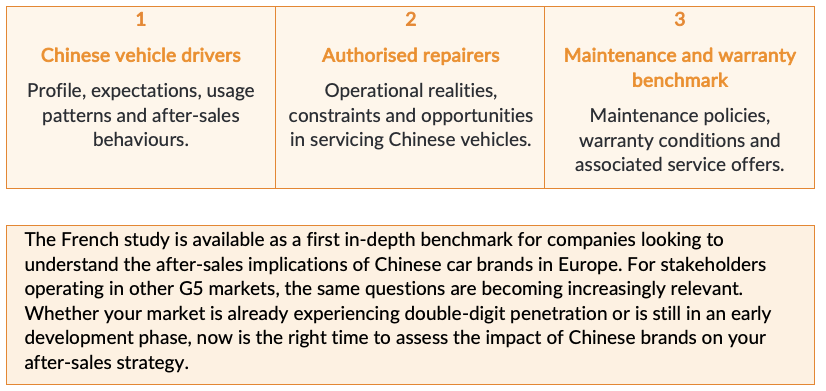
GiPA can support aftermarket players with country-specific studies designed to analyse the penetration, distribution models, repair ecosystem, parts challenges, technical access and service policies of Chinese brands in your local market.
To access the French study or request a dedicated analysis for your country, contact GiPA at [email protected] and start building a clearer view of how Chinese car brands may transform your aftermarket landscape.