
From data to direction: what really matters in Aftermarket Intelligence? Categories: 2026, News Timelines: Argentina, Brazil, Central America, Chile, China, Colombia, France, Germany, India, Italy, Mexico, Morocco, Peru, Poland, Portugal, South Africa, Spain, Thailand, Turkey, Ukraine, United Kingdom, Vietnam
Announcement Date : 12 May 2026
In the automotive aftermarket, the word “data” is used constantly. We speak about car parc, mileage, vehicle age, registrations, workshop entries, product volumes, prices, distribution channels and customer behaviour as if their strategic meaning were immediately clear. But data, by itself, does not create direction. The real question is whether they are able to transform this information into a clearer understanding of the market, better decisions and stronger future positioning. This distinction is becoming increasingly important. The aftermarket is going through a period of deep transformation: vehicle technologies are changing, the car parc is becoming more complex, customer expectations are evolving, channels are being reshaped and workshops are being asked to adapt to new forms of maintenance and repair.
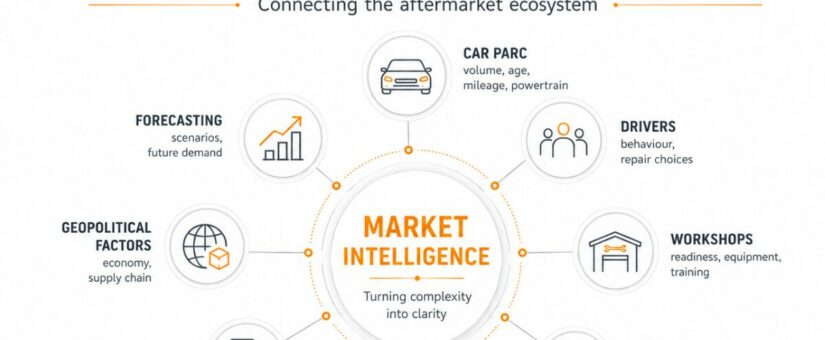
At GiPA, after more than 40 years of collecting and analysing aftermarket data, we know that market reality is never found in one single figure. Car parc volume is essential, but it only becomes truly meaningful when it is connected with other dimensions: vehicle age, mileage, engine type, regional concentration, driver behaviour, workshop readiness, parts value potential and the actual capacity of the market to absorb change.
A market may show growth in vehicle registrations, but this does not automatically translate into immediate aftermarket potential. A product family may appear promising in volume, but the real business opportunity depends on timing, value, technology complexity, repair frequency and the ability of the distribution and repair ecosystem to respond. A region may not be the largest in terms of parc size, but it may offer higher profitability, stronger product potential or a more favourable competitive environment.
The electric vehicle transition offers a clear example. Counting the number of EVs in circulation is only the starting point. It tells us that the parc is changing, but it does not explain how the aftermarket should prepare. To understand the real impact of electrification, we need to go further.
How satisfied are EV drivers? What frictions do they face? Where do they service their vehicles? Are independent workshops ready to welcome them? Do repairers have the right equipment, training and confidence? Which product categories will lose frequency, and which will gain value through higher complexity?
GiPA studies show that EV drivers may express high satisfaction with the vehicle itself, while still facing very concrete obstacles linked to the surrounding ecosystem: charging availability, charging price, home installation and the capacity of workshops to service these vehicles effectively.For parts manufacturers, this means that product launches cannot be planned only around theoretical car parc evolution.
They must also take into account workshop readiness, training needs, equipment gaps, channel dynamics and the speed at which repairers are able to integrate new technologies into their daily operations.For distributors, the same logic applies. Stock decisions, sales support, technical services and regional priorities require a more precise reading of demand. It is not enough to know where the vehicles are. It is necessary to understand where the opportunity is mature, where it is emerging and where additional support is needed before the opportunity can fully develop.
Some product categories may decline in replacement frequency but increase in value because parts are more complex, more technical or more expensive. Some mature segments may remain highly strategic because ageing vehicles continue to require maintenance. Some fast-growing technologies may take longer to generate real aftermarket demand than expected.
Some regions may offer limited volume growth but stronger profitability.Without connecting volume and value, the market picture remains incomplete. Forecasting therefore means building scenarios, identifying risks and opportunities, and helping companies make decisions with greater confidence.
Through GiPA’s forecasting tools, car parc evolution, product demand, technology trends, workshop behaviour, driver expectations and external variables such as regulation, economic conditions, geopolitical factors and weather conditions can be combined to provide a more complete view of future aftermarket potential.The goal is to ask better questions.
Where will demand grow, and when?
Which product families will gain value, even if volumes decline?
Which channels are best positioned to capture future opportunities?
Where are workshops ready, and where do they need support?
Which regions should be prioritised for sales, stock, training or brand development?
How can companies anticipate change before it becomes visible in sales figures?
The companies that will lead the aftermarket in the coming years will not necessarily be those with the largest amount of data. They will be those able to connect the right sources, interpret the right signals and act on the right insights.
 This is the purpose of GiPA Big Data Service.Designed as a tailor-made approach, GiPA Big Data Service combines the customer’s own information with GiPA’s market intelligence, historical databases and forecasting expertise. Together with each customer, GiPA defines the business question, identifies the most relevant data sources and transforms them into actionable insights for strategy, sales, product development, pricing and market planning.Because data only becomes powerful when it answers the right question. And in a market as complex and fast-changing as the aftermarket, asking the right question is often the first real competitive advantage.